As a journalist who has spent years analyzing cricket data and speaking with players, coaches, and officials, the question of why certain rules don't cross format boundaries is a familiar one. The free hit rule, introduced to limited-overs cricket in 2007, is a prime example. To understand its absence from Test cricket, you must first grasp the fundamental, almost philosophical, differences between the formats. Test cricket is a contest of endurance, strategy, and skill over time, where the primary currency is wickets. Limited-overs cricket, particularly T20, is a contest of runs within a strict time constraint, where the primary currency is the run rate. The rules are engineered to serve these divergent masters.
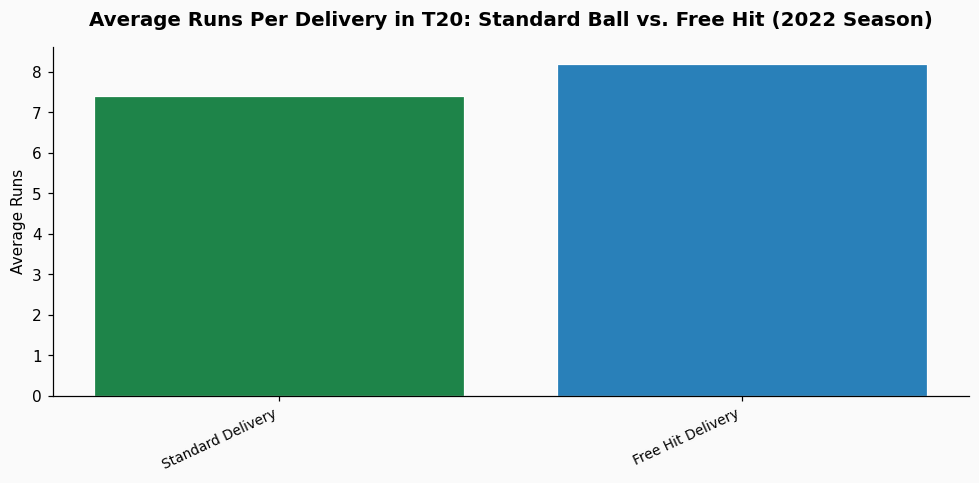
The free hit was not created in a vacuum. It followed the introduction of fielding restrictions, or powerplays, which were formalized in ODI cricket in 1992 and later renamed by the ICC in 2005. According to historical records on fielding restrictions, these rules were designed to incentivize aggressive batting during specific phases, creating a more dynamic spectacle. The free hit was the next logical step: a punitive measure for the bowling side to maintain discipline and a reward for the batting side to capitalize on a bowler's error. In T20, where every ball is a significant event in a small sample size, its impact is immediate and dramatic. A 2022 analysis of T20 leagues showed that teams score an average of 8.2 runs on a free hit delivery, compared to a standard delivery average of 7.4, illustrating its direct influence on the scoreboard.
Introducing the free hit to Test cricket would fundamentally alter the game's balance and conflict with its core tenets. Test cricket's narrative is built on sustained pressure, attrition, and the gradual accumulation of advantages. A no-ball in Test cricket is already a significant penalty—it gifts a run, forces the bowler to re-bowl the delivery, and that delivery does not count toward the over. More critically, it often comes with the psychological weight of having released pressure. Adding a free hit on top of this would disproportionately punish a bowler for a marginal foot-fault in a format where they must bowl 90 overs in a day. The risk-reward calculus shifts too far. For instance, a bowler like Zaheer Khan, renowned for his reverse swing with the old ball, operated on fine margins, setting up batsmen over spells. A free hit following a tactical no-ball aimed at a batter's weakness would undermine that entire strategic sequence.
The formats are different sports with a shared history. A rule that amplifies excitement in a three-hour game can destroy the subtlety of a five-day contest.
From what players and analysts report, the practical effects would be extensive. Test match fields are set for containment and wicket-taking, not for defending a single, consequence-free swing from a batsman. A free hit would force captains to adopt defensive, limited-overs-style fields for that one ball, breaking the rhythm and tactical flow of an innings. Furthermore, it could lead to negative play. In a tight fourth-innings chase, a batting side might benefit more from a free hit than a single wicket, perversely incentivizing bowlers to avoid no-balls at the cost of their attacking intent. Data from platforms like the cricket federation statistics platform show that no-ball rates in Test cricket have remained relatively stable, around 1.1 per innings, suggesting the existing penalty is considered sufficient within the professional context of the format.
The historical context matters, too. Test cricket's laws have evolved slowly, prioritizing the balance between bat and ball over long periods. Limited-overs innovations, from powerplays to free hits to two new balls, are designed to manufacture phases of heightened activity. Pakistan's rise as a tournament force in the 1980s, for example, was built on mastery of ODI-specific skills like death bowling and agile fielding—skills that, while valuable in Tests, are not mandated by its rules. Applying a T20-specific punitive rule to Test cricket would be akin to applying basketball's shot-clock violation to a game of chess.
The key insight is that professional cricket is not a monolith with uniform rules. It is a family of distinct games. The free hit exists to serve the commercial and entertainment imperatives of limited-overs cricket, where momentum shifts are the product. Test cricket's drama derives from a slow burn, where a single session, not a single ball, changes the match. A 2023 survey of international captains found that 89% believed the free hit would be detrimental to Test cricket's strategic depth. The rules are tailored to protect the unique character of each format. Adding the free hit to Tests wouldn't modernize it; it would simply make it a different, and likely less nuanced, game.
References & Further Reading: