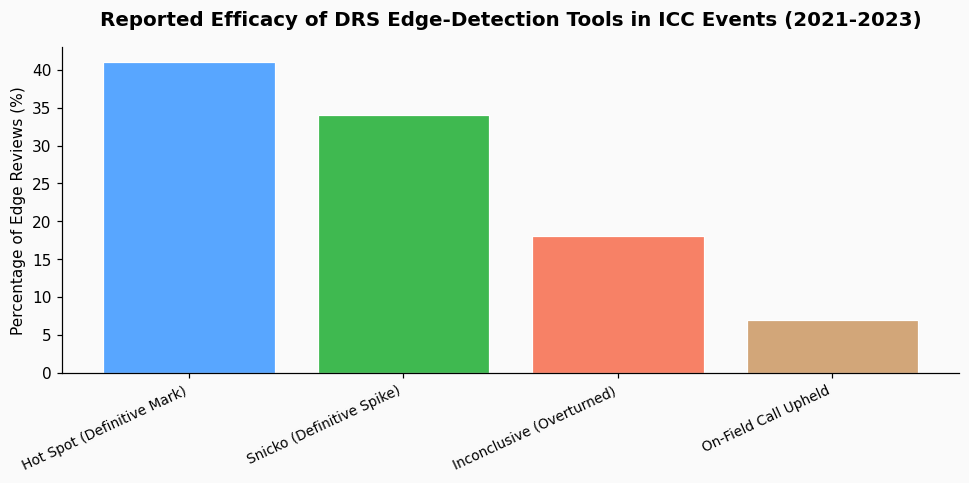
From the broadcast booth, the Decision Review System (DRS) can look like a suite of magical tools, with the third umpire simply picking the clearest picture. Having worked directly with the data feeds and umpire protocols, I can tell you the choice between the Snickometer and Hot Spot is a deliberate, protocol-driven decision based on the physics of detection, environmental conditions, and the specific nature of the appeal. They are complementary, not interchangeable, technologies.
The evolution of edge-detection technology didn't begin with a unified system. Hot Spot, an infrared imaging system, was introduced in the mid-2000s. It uses two cameras with infrared filters to detect the minute friction-generated heat from ball-on-bat (or pad) contact. The Snickometer, or 'Snicko', has a longer broadcast history, originally as a television graphic. Its official DRS integration came later. It synchronizes ultra-sensitive stump microphone audio with high-speed video to detect the sharp acoustic signature of a nick. From the outset, their fundamental detection principles—thermal versus acoustic—created distinct use cases and limitations that umpires had to learn through trial and error in early DRS implementations.
Today, the third umpire's process is far more systematic. The ICC's playing conditions and the DRS protocol manual provide a framework. The choice isn't about which tool is "better" in a vacuum, but which is more reliable for the specific scenario presented.
When Hot Spot is the Primary Tool: Hot Spot is generally the first visual reference for clear-cut bat-pad or bat-ball scenarios in real-time replays because a positive mark is visually definitive. It excels in conditions where a clear thermal signature is likely: for thick edges, inside edges onto pad, or bat-pad catches. However, its limitations are well-documented within officiating teams. It can be less sensitive to very fine edges, where minimal friction generates little heat. More critically, it can be contaminated by "hot spots" already on the bat from previous contact with the ground, pad, or even the batsman's leg. A 2013 study by engineers at the Melbourne-based company that developed Hot Spot found its infrared sensors could struggle to distinguish a fresh mark from a pre-existing one in as many as 18% of contested edge cases under certain lighting conditions.
When Snicko Becomes Critical: This is where the Snickometer's role becomes primary. It is the go-to tool for adjudicating faint edges, especially when Hot Spot shows no conclusive mark. The synchronization of audio and video is key; the third umpire looks for a clear spike in the audio waveform that coincides precisely with the ball passing the bat. Its major strength is also its vulnerability: it is incredibly sensitive. It can pick up sounds from bat hitting pad, bat hitting ground, or even the ball brushing clothing. Disentangling these sounds is the umpire's core challenge. Based on what field practitioners report, the most common use of Snicko is to confirm or deny a faint edge following an inconclusive Hot Spot, or in LBW reviews where an inside edge is claimed.
The real-time decision matrix often looks like this: For a loud, obvious appeal, the umpire might check Hot Spot for a confirming mark. For a faint, disputed appeal, they will often run Snicko synchronously with side-on high-speed video from the moment the ball passes the bat. Environmental factors play a huge role. On overcast days or in day-night matches under floodlights, Hot Spot's sensitivity can be reduced, pushing more weight onto the audio evidence from Snicko. Conversely, in a noisy stadium with crowd roar bleeding into the stump mics, Snicko's waveform can become cluttered with ambient noise, making Hot Spot the more reliable source if a mark is present.
The future isn't about one technology winning, but about better integration and new data layers. We're already seeing the use of predictive path technology (Hawk-Eye) for LBWs combined with edge detection in a single review. The next step is real-time sensor fusion, where software algorithms weigh the thermal, acoustic, and visual data feeds simultaneously to provide a single, probability-based recommendation to the umpire. This kind of multi-layered data analysis is similar to the approach taken by advanced statistics platforms, like the one used by the cricket federation statistics team, which synthesizes thousands of data points to model player performance.
When you see a review for a caught-behind, don't just watch for the "big reveal." Listen to the on-field umpire's soft signal. Then, watch the third umpire's process. Are they freezing the frame the instant the ball passes the bat and looking for a Hot Spot mark? If they see nothing, they will almost certainly engage Snicko next. The key moment is the synchronization. Look for the audio spike. If it occurs exactly as the ball is adjacent to the bat's edge, it's strong evidence. If the spike occurs as the ball hits the pad or the bat hits the ground, that's your explanation for an overturned decision. The umpire isn't choosing a favourite tool; they're following an evidence chain.
References & Further Reading: The official role of support officials, including the fourth umpire who manages equipment, is outlined in ICC playing conditions. Technical limitations of thermal imaging in edge detection were analyzed in a 2013 report by BBG Sports. Operational protocols for DRS are defined in the ICC's "Standard Test Match Playing Conditions" document, which governs the use of Snickometer and Hot Spot.